Huff-Duff
The Good ShepherdHuff-Duff, the shipboard term for high-frequency direction finding, gives Keeling a way to turn foreign radio transmissions into bearings and actionable warnings about U-boat activity. Its reports do not reveal an enemy submarine directly, but they make the invisible threat more locatable: first as a transmission fifteen to twenty miles away, then as an enemy concentration almost on Keeling’s position, and later as multiple transmissions ahead of the convoy. The equipment’s importance lies in that conversion of signal into command information—and in the limits imposed by uncertainty and delay.
Function and Reporting
The narrative identifies Huff-Duff as HFDF, or high-frequency direction finding. Its reports provide bearings associated with foreign transmissions; in one message the report also gives a range estimate. The evidence describes what the equipment contributes to the ship’s decisions, rather than its construction or the technical process by which it obtains a bearing.
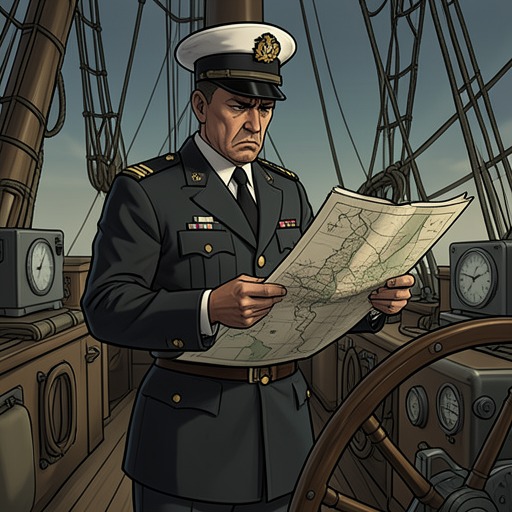
Information reaches Krause through a human reporting chain. A signalman reads out a message from the convoy commander to the escort commander and hesitates at the unfamiliar term Huff-Duff. Krause supplies the explanation testily, after which the signalman continues with the report. He then transmits Keeling’s reply, which the signalman repeats back for confirmation. The exchange makes the instrument’s usefulness dependent not only on detection, but also on a correctly understood, relayed, and acknowledged message.
A Bearing Becomes a Decision
The first significant report gives a foreign transmission on bearing 087, at a range of fifteen to twenty miles. Krause reads the bearing against the convoy’s course and judges that it lies nearly in the convoy’s path. In the Atlantic, he reasons, a foreign transmission can mean only one thing: a U-boat in the vicinity. The report is more positive than James’s earlier possible contact, which had left open whether a U-boat was present at all.
Krause responds by ordering Keeling to run the contact down. The bearing does not remove the need for judgment; it narrows the problem enough to demand action. The instrument supplies a direction and a reported distance, while Krause must interpret their significance in relation to the convoy and decide what to do next. Huff-Duff therefore functions as an early-warning and locating aid, not as a substitute for command decisions or direct underwater contact.
Enemy Concentration and Delayed Warning
A later Admiralty message, carried to Krause while Keeling is already engaged in the search, reports that Huff-Duff indicates an enemy concentration and recommends a radical change of course southward. The latitude and longitude accompanying the warning appear immediately familiar to Krause: within a mile or two, they place Keeling where it is at that moment, amid the U-boat wolf-pack.
The warning’s precision does not make it timely. It is two hours old, and the convoy is already well closed up and moving forward with substantial momentum. A change of course would take time to relay to every ship, then require an unscheduled turn that could renew disorder and straggling. Huff-Duff has helped identify the danger, but the interval between detection, transmission, and receipt has narrowed the opportunity to avoid it. The episode distinguishes accurate information from information that can still be acted on in time.
Multiple Transmissions and the Limits of Inference
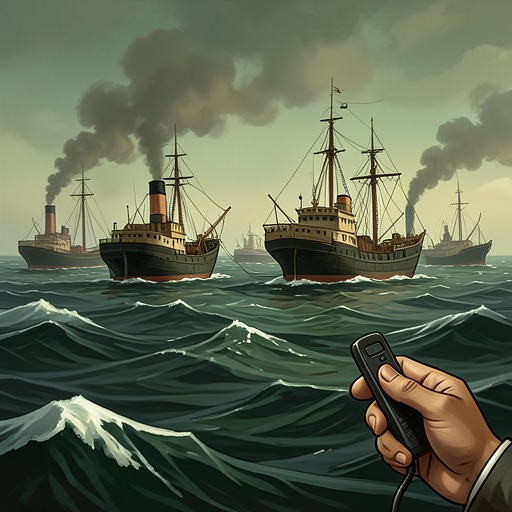
Later, as Keeling draws ahead of Cadena, the Commodore reports numerous foreign-language transmissions ten to fifteen miles ahead, on various bearings. Krause interprets the traffic as evidence that U-boats are communicating with one another or reporting their plans to a coordinating authority. The report broadens the threat picture from a single contact to several possible participants, but the precise content and purpose of the messages remain unknown. The transmissions are evidence of activity, not a decoded account of the enemy’s intentions.
That distinction defines Huff-Duff’s narrative role. It makes radio traffic spatially meaningful and can reveal that hostile activity is concentrated near the convoy, yet it cannot by itself identify every sender, explain every transmission, or ensure that a warning arrives while maneuver remains practical. The reports enter a ship already balancing immediate action against the demands of escorting a vulnerable convoy. Their force comes from what they establish—and from the decisions and uncertainties they leave to the people receiving them.